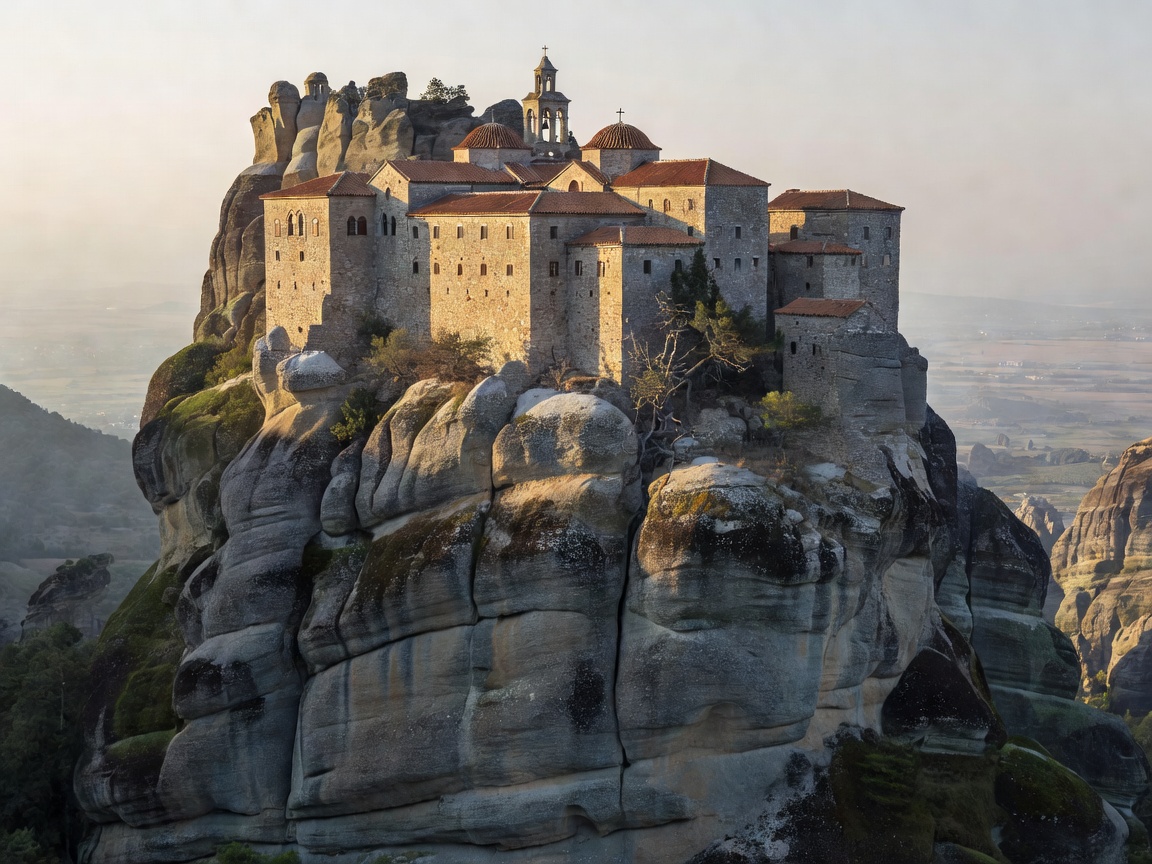
Geological Formation and Hermit Origins
Rising dramatically from the flat Thessalian Plain near the towns of Kalabaka and Kastraki, Meteora—translating literally as "suspended in the air"—comprises more than a thousand sheer sandstone and conglomerate pillars reaching heights of up to 400 meters. Formed approximately 60 million years ago during the Paleogene period, these rock towers were sculpted by continuous tectonic uplifts, seismic faulting, and water weathering of river-deposited pebble sediment.
In the ninth and tenth centuries CE, ascetic Byzantine hermits began occupying fissures and hollows high in the vertical rock faces. Seeking solitary contemplation removed from secular strife, early monks lived in precarious cliff cavities accessible only via rope ladders and wooden scaffolding lashed to the stone. By the fourteenth century, under the leadership of Saint Athanasios the Meteorite, organized cenobitic monasticism began constructing permanent stone retreats on the summit plateaus.
The Six Functioning Byzantine Monasteries
Of the twenty-four monasteries founded during the late Byzantine and Ottoman eras, six remain fully operational and open to the public:
1. Monastery of Great Meteoron (Megalo Meteoron): The oldest, largest, and highest of the complexes, founded in the 14th century. Its katholikon (main church) features breathtaking post-Byzantine frescoes of the Cretan school and historical artifacts including ancient windlass winches and wooden bread ovens.
2. Monastery of Varlaam: Founded by the monk Varlaam in the 1300s and expanded by the brothers Theophanes and Nektarios Apsarades in 1517. It preserves an original wooden cargo net suspended by hemp ropes over a 370-meter abyss, used until modern stone staircases were chiseled in the 1920s.
3. Monastery of Roussanou: Occupying a narrow vertical pinnacle, this convent features a lower footprint and graceful footbridges spanning chasms between sister spires. Its 16th-century wall paintings depict the martyrdom of early Christian saints.
4. Monastery of the Holy Trinity (Agia Triada): Positioned atop an isolated, sheer cylindrical pillar made famous by its appearance in international cinema. Access demands descending a deep ravine and ascending 140 steep stone steps carved into the rock.
5. Monastery of Saint Stephen (Agios Stefanos): A peaceful nunnery accessible via a level stone bridge without steep cliff stairs, making it accessible to visitors with reduced mobility.
6. Monastery of Saint Nicholas Anapausas: Built on a remarkably cramped rock footprint, forcing its architects to build upward in three vertical tiers rather than expanding outward horizontally.
Rotational Closures and Modesty Protocols
To balance spiritual monastic discipline with tourism, each monastery closes on a different designated day of the week on a rolling schedule. No single day sees all six monasteries open simultaneously; visitors seeking to tour all six must spread their visits across at least two full calendar days.
Dress codes are rigorously enforced at all entrance portals. Men must wear long trousers; shorts or sleeveless shirts are prohibited. Women are required to wear long skirts extending below the knee; trousers are not permitted for women inside consecrated areas. While wraparound skirts are loaned at entrances, bringing appropriate personal attire prevents delays. Photography inside consecrated katholikon chapels is strictly forbidden.
Comparative Transit Options: Rail vs. Car Rental
Mainline Rail & Regional Bus (KTEL)
- Direct or single-transfer train routes from Athens Larissa Station to Kalabaka.
- Eliminates highway navigation and high mainland motorway toll fees.
- Local taxi services and daily circular shuttle buses connect Kalabaka to monastery loops.
- Fixed timetable constraints reduce flexibility for early sunrise or late sunset photography.
Private Vehicle Rental from Athens / Thessaloniki
- Complete autonomy to explore sunset panoramic lookouts (e.g., Psaropetra).
- Easy access to traditional stone villages in the surrounding Pindus mountain foothills.
- Permits early-morning arrivals before organized coach tours reach Great Meteoron.
- Limited parking at small monastery turnouts during late-morning peak hours.
Practical Navigation and Walking Routes
While an asphalt ring road links all six monasteries, ancient stone footpath trails (monopatia) offer an incomparable wilderness perspective. The marked trail from Kastraki up to Great Meteoron winds beneath immense conglomerate walls where birds of prey nest in sandstone crevices. Begin ascents in the early morning at 08:30 to avoid mid-day heat and road exhaust from tour buses.
Kalabaka and the smaller village of Kastraki both offer plentiful base accommodation. Kastraki sits nestled immediately beneath the dark rock towers and provides direct pedestrian trail access, while Kalabaka features the primary rail terminus, commercial services, and the 11th-century Byzantine Church of the Dormition of the Virgin.