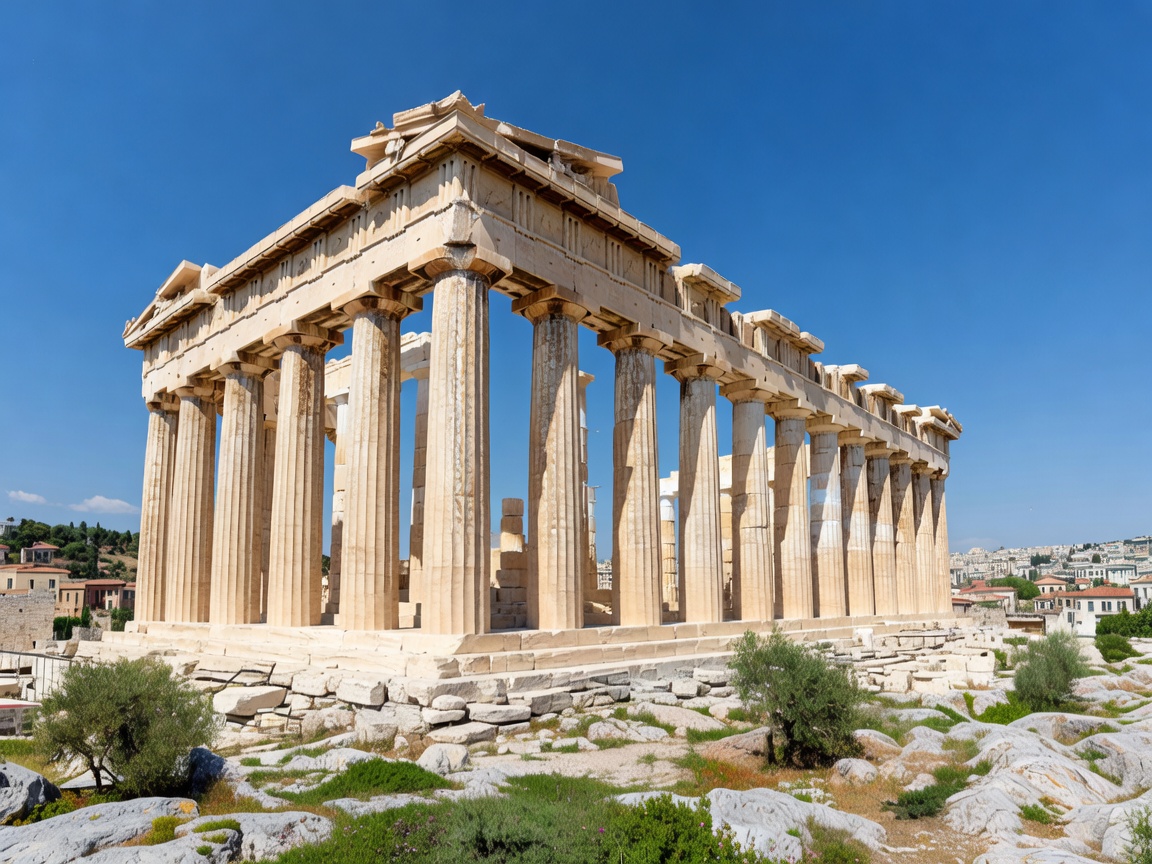
The Limestone Citadel and Periclean Architecture
Rising 156 meters above the Attic plain, the Acropolis plateau serves as the physical and symbolic anchor of the Greek capital. Built largely under the direction of Pericles during the Golden Age of Athens in the fifth century BCE, the complex remains an extraordinary study in architectural proportions, optical refinements, and classical civic engineering. The central monument, the Parthenon, was conceived by architects Ictinus and Callicrates with sculptural oversight by Phidias. What makes the monument remarkable to the architectural eye is the deliberate absence of straight lines: every column leans imperceptibly inward, the stylobate exhibits a subtle upward convex curvature, and the corner columns are widened to avoid appearing fragile against the blinding bright sky.
Adjacent to the Parthenon stands the Erechtheion, constructed between 421 and 406 BCE. Unlike the symmetric Doric order of the main temple, the Erechtheion accommodates steep slope variations on the north slope with an intricate Ionic design, celebrated for its Caryatid Porch—where six sculpted maiden figures substitute for classical fluted stone columns. Below the summit lies the Odeon of Herodes Atticus, a Roman-era stone theater completed in 161 CE that continues to stage international theater and classical symphonies during the annual Athens & Epidaurus Festival.
Urban Walking Axis: Dionysiou Areopagitou & The Agora
To experience Athens as a continuous pedestrian urban landscape, the primary approach begins along Dionysiou Areopagitou, the wide, paved pedestrian promenade that fringes the southern slope of the citadel. Passing the modern Acropolis Museum—designed by architect Bernard Tschumi to house surviving friezes directly opposite the monument—the stone footpath continues past the Hill of the Pnyx, the original meeting place of the Athenian democratic assembly.
Descending toward the northwest brings visitors to the Ancient Agora of Athens, the commercial and political core of classical civic life. Here, the Temple of Hephaestus remains one of the best-preserved Doric temples in the Mediterranean basin, retaining its complete perimeter columns and portions of its pediment decoration. Walking through the reconstructed Stoa of Attalos reveals how two-story colonnades shielded citizens from torrential winter rains and unrelenting summer sun while hosting commercial shops and public philosophical discourse.
Plaka and Anafiotika: Vernacular Contrasts
Bordering the northern flank of the Acropolis hill sits Plaka, the oldest continuously inhabited quarter in Athens. Built over the ruins of ancient residential dwellings, Plaka combines neoclassical townhouses with traditional tavernas, winding flagstone staircases, and family-run workshops. Tucked directly beneath the Acropolis rock wall is Anafiotika, an enclave constructed in the mid-nineteenth century by stonemasons from the Cycladic island of Anafi who moved to Athens to construct King Otto’s Royal Palace.
Anafiotika functions as a miniature Aegean island suspended over the urban sprawl: whitewashed stone walls, small timber doorways painted sea-blue, bougainvillea hanging over narrow corridors too cramped for motorized transport, and quiet shaded courtyards. It offers an essential stylistic foil to the rigid symmetry and colossal scale of the civic monuments towering overhead.
Comparative Planning: Timing, Ticketing & Seasons
Pros & Strengths
- Unmatched concentration of high-classical Western architecture within walkable radius.
- Exceptional museum infrastructure (Acropolis Museum, National Archaeological Museum).
- Efficient underground Metro network connecting airport, port, and city centre directly.
- Vibrant culinary and night cafe culture across Monastiraki, Koukaki, and Pangrati.
Cons & Constraints
- Midsummer afternoon heat can exceed 40°C, prompting temporary Acropolis closures.
- Strict timed-entry slots require advance reservation to guarantee admission.
- Plaka’s primary arteries feature commercial tourist merchandise shops.
- Steep polished limestone paving becomes slick underfoot during rainfall or worn soles.
Practical Navigation and Transit Tips
The Hellenic Ministry of Culture enforces timed entry slots for the Acropolis. Plan for an 08:00 morning arrival to clear security before tour coaches arrive, or book the final afternoon slot after 17:00 when limestone shadows lengthen across the agora basin. Avoid mid-day visits between 12:00 and 15:30 from June through August. Wear footwear with substantial rubber tread, as centuries of footfall have polished the bedrock of the Propylaea into slick surfaces.
For public transit, the Metro Blue Line (Line 3) runs directly from Athens International Airport (Eleftherios Venizelos) to Syntagma and Monastiraki stations, while the Green Line (Line 1) connects central Athens directly to Piraeus port terminal gates for ferry connections to the Cyclades and Dodecanese.